Ownership and a traceable history
Receipt, registration, assignment and completion need to work together. We define roles, deadlines and links between documents and cases so that the next action has a clear owner.

Bring document handling, responsibilities and retention together. We provide advice, assessments and DEPO, with a clear distinction between everyday operations and the rules that apply in your country.
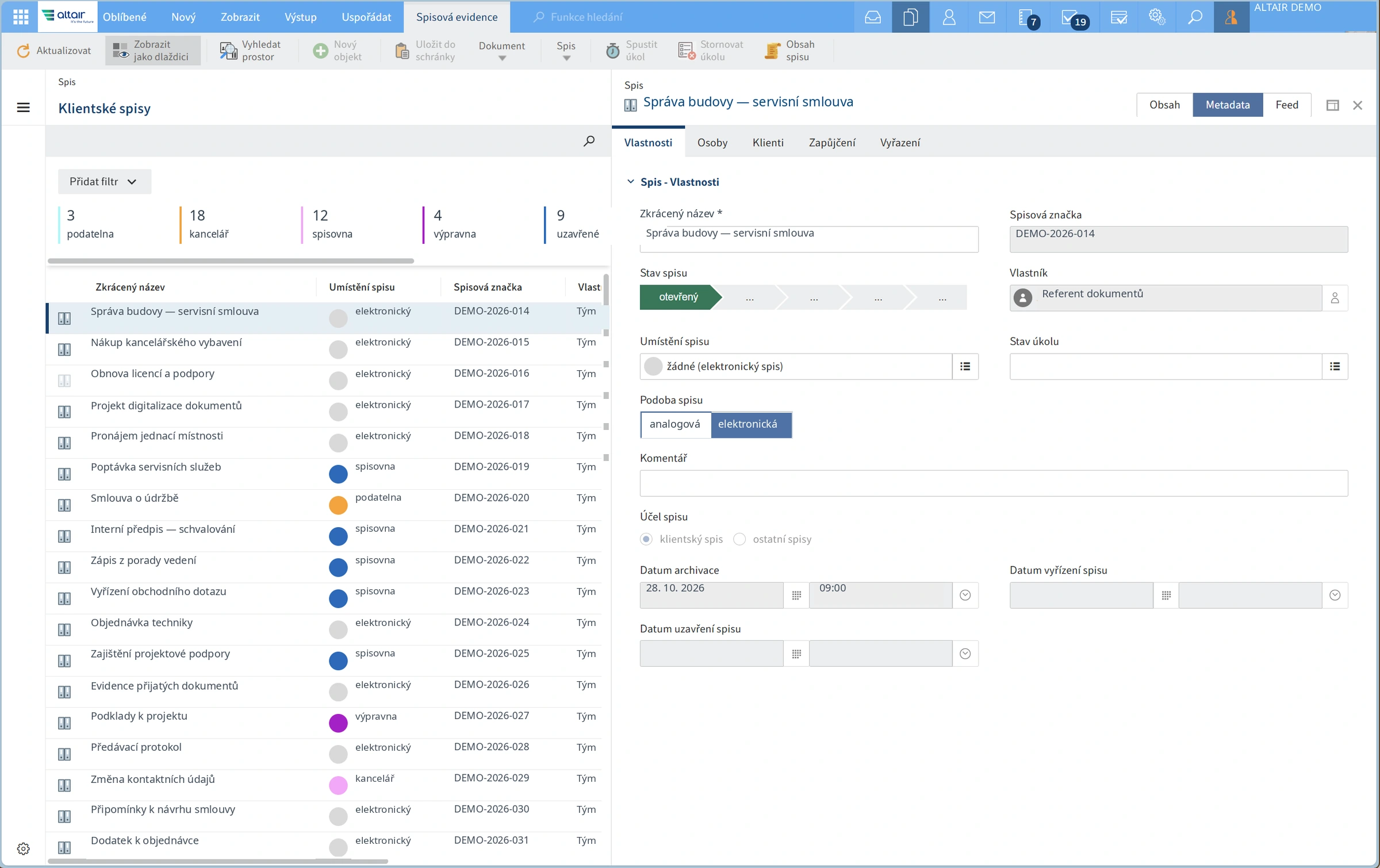
Receipt, registration, assignment and completion need to work together. We define roles, deadlines and links between documents and cases so that the next action has a clear owner.
Internal policies and system settings should describe the same process. We compare documentation with everyday practice and identify changes for records staff, users and administrators.
Contracts or invoices may originate in another application. We define where they are registered and how documents and data are handed over, avoiding repeated data entry.
We supply DEPO and also advise organisations using other vendors' systems. Recommendations are based on what needs to improve, not on a requirement to replace the software.
The working concepts are familiar: classification, retention, access, disposal and archival transfer. Legal duties vary by country and sector. English-language content does not imply that Czech eSSL rules apply internationally.

Receipt or creation → Registration and filing → Routing and handling → Completion and closure → Storage and retention periods → Appraisal procedure → Transfer to archive / Authorised destruction. The procedure determines the outcome; not every document is transferred to an archive.
A DMS supports document work and workflows. Czech eSSL also addresses the statutory registration and lifecycle requirements of the organisation concerned. The systems can work together, but a general DMS is not automatically an eSSL.
The organisation's status and Act No. 499/2004 Coll., particularly sections 3 and 63, determine the duties. Retaining documents, performing statutory records management and using attested eSSL are different requirements with their own conditions and exceptions.
Their existence, location and link to the electronic record still need to be managed. A scan can help everyday work but does not necessarily replace the original. Conversion and retention must follow the applicable rules.
No. The data-box service is a communication channel. The organisation still needs to receive messages and attachments, register them, retain relevant information and manage the document lifecycle.
The content and its connection to the organisation's work matter, not email as a channel alone. Procedures should define what must be captured, where and by whom. Routine technical traffic and substantive business records need to be distinguished.
A document is an individual record; a case file brings related records together. Storing files side by side is not enough. Relationships, completion status and closure and retention rules also matter.
Define the records, metadata, responsibilities, retention and any link to the main records system. Czech separate registers have specific requirements. Being a standalone application does not by itself establish that legal status.
Not automatically. Follow the applicable appraisal and disposal procedure, including archival selection where required. Other retention duties or a hold may prevent deletion even after the scheduled period.
A Submission Information Package carries documents and related metadata into an archival process. It is not simply a ZIP of files. Its structure and validation depend on the applicable standard and receiving archive.
It assesses a system against specified Czech requirements. Check the actual product, version and validity. It does not confirm that every customer has configured and used the system correctly, or that another country's rules are met.
Consult the official information from the Czech Standardization Agency's attestation centre and the Ministry of the Interior. Match it to the offered system and request the relevant evidence from the supplier.
No. Product assessment and review of an organisation's practices serve different purposes. A review can reveal gaps between internal procedures, configuration and what staff actually do.
The visible mark alone does not establish the signer's identity or document integrity. Distinguish appearance, the signing technology and the level required for the transaction, including in a signing workspace.
Obtain data descriptions and exports early, map document and case relationships, and agree how open work will continue. Trial migration and result checks belong in the plan before the old system is retired.
Agree export of documents, metadata and relationships, interface documentation and exit assistance. Test whether the export is usable. Being able to download files is not the same as transferring the whole solution.
No. Backup primarily supports recovery after loss or failure. Preservation also addresses readability, metadata, provenance and controlled handling over time. Both are needed, but they serve different purposes.
No. Language is separate from legal requirements. Retention, disposal, signatures, access and archival transfer must be designed for the jurisdiction and sector in which the system is used.
No. It is guidance for records management by public authorities. A supplier's software and the organisation's procedures need to be assessed against the requirements that actually apply to the project.